Bruna Bertoni
The encounter
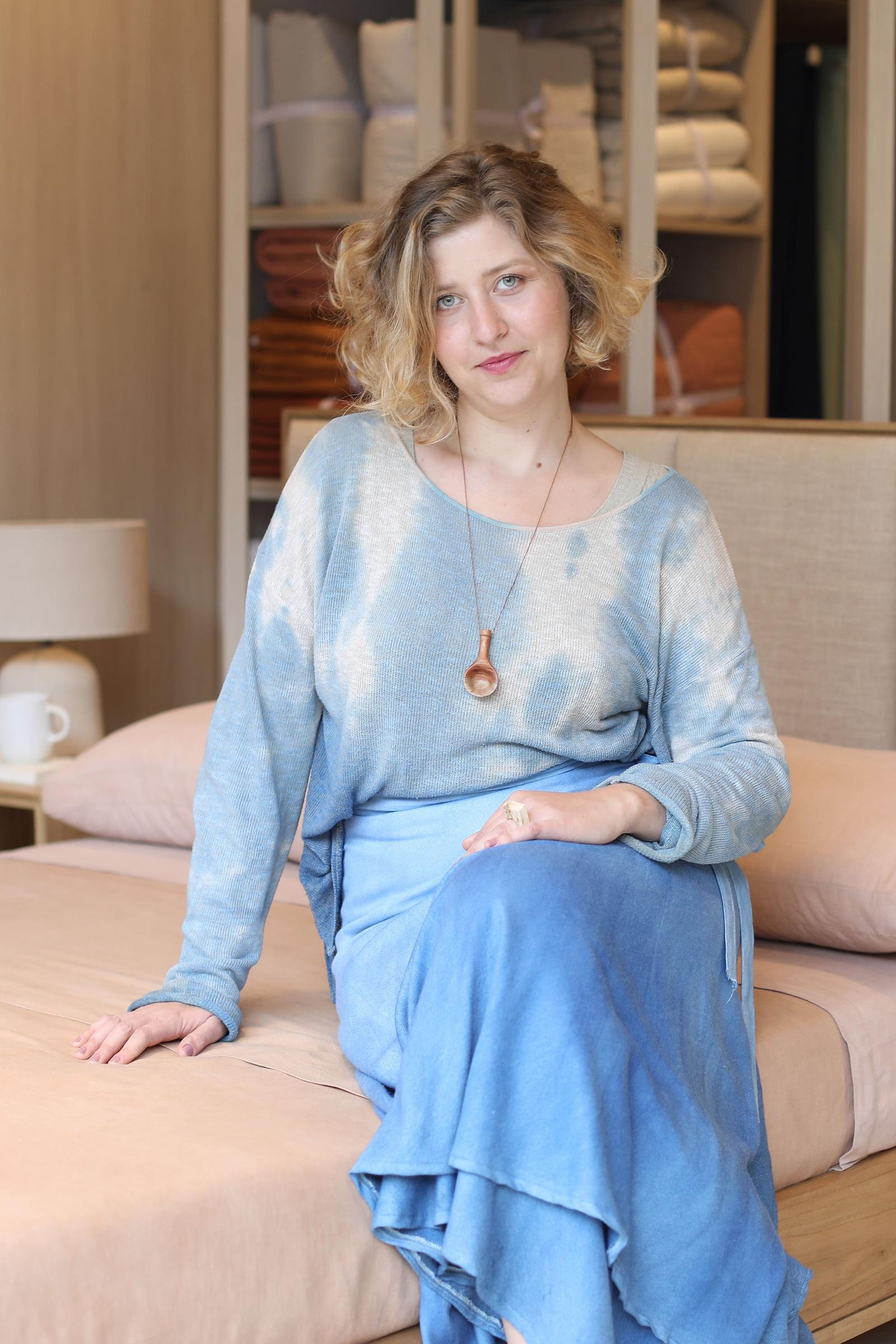
Her contact with material began early. Bruna grew up close to the world of textiles, following the work of her mother, who has always worked in the field. Her childhood was also shaped by the garden, by plants and by play outdoors. Years later, those memories resurface in another form, in her practice of natural dyeing.
While studying Arts and Design at the Federal University of Juiz de Fora, her artistic repertoire broadened and making by hand took on a central role. The path to natural dyeing unfolded organically: returning to work with her hands, Bruna drew closer to gathering plants, experimenting with them and investigating colour on cloth.
Between painting and dyeing, she began to build a language of her own, in which material is no longer just a support but takes part in the creative process.
The journey
Her studies in Arts and Design at the Federal University of Juiz de Fora broadened Bruna's repertoire and laid the foundations of a practice that moves between art, design and textile experimentation. Her path then led to Portugal and later to Denmark, where new landscapes, plants and ways of making expanded her research.
During this period, Bruna presented her work to different audiences and took part in projects linked to sustainability, encountering other territories and other perspectives on material, production and making by hand.
Returning to Brazil brought another movement: the wish to deepen her relationship with her own land and to investigate the diversity of materials, plants and knowledge that run through her culture. It is in this meeting between experiences gathered in different places and a return to origins that Lapso's research unfolds — as a practice in constant construction.
The atelier as method
The Lapso atelier is laboratory, archive and meeting point. It is where colours are developed, materials investigated and processes tested. Over time, these processes build a material memory of the practice.
The workshops extend this research. Hands-on work with natural dyes trains the eye on temperature, time, concentration, preparation of the material and the behaviour of fibres, connecting technique and result.
More than teaching a recipe, the aim is to develop an investigative eye: to observe, compare, test, and turn curiosity into creative practice and technical knowledge.
Visit the atelier